









 5 min read



If you’re like me and spend your first waking moments catching up on the news, you’re probably exhausted. The headlines suck you in, only for the article to then stir up a whirlwind of aggravation. Let’s just say managing these reactions has become a fine art.
Now, with everything going on today — the ever-changing tariff landscape, uncertainty surrounding significant global conflicts, and earnings surprises cutting both ways — it can feel impossible to sit down and think slowly and critically about your equity portfolio.
Here’s the truth, though: there’ll be no end to big headlines and no “perfect” allocation. One of the few things investors can do in this environment is stick to a reliable framework that suits their horizon and needs. For some of us, factor investing can be a valuable part of that.
The fact(ors) of the matter
For the sake of this discussion, we’ll define factors as characteristics that can help explain investment performance in the equity markets. Investors often calibrate exposures to different factors in efforts to help lower risk, increase diversification, and/or capture excess returns. You won’t be surprised by the factors we’ll touch on here; value, momentum, and growth have dominated performance-focused headlines over the last decade.
Over the last ten years, some of these factors have outperformed the market, while others have matched or underperformed. The factor rotations we’ve witnessed are largely related to hiccups and growing pains in the macro economy; think tech selloffs, changes to interest rate regimes, and global trade order reorganizations. Some investors might choose to tilt their portfolios around these rotations, others focus more on the outcomes from bottom-up stock selection, and still others take a wholly more passive approach that prioritizes broad market exposure. Let’s have a look at what each factor claims to offer.
Value investing: Shooting for under par
Let’s define the value factor as attempting to capture excess returns of stocks that are priced at a discount relative to their fundamental intrinsic value. Basically, the value factor is aiming to get more for less, if you will; it’s trying to complete the course in fewer strokes than anticipated. As we saw in Augusta, though, coming in under isn’t always enough to best the reigning champ.
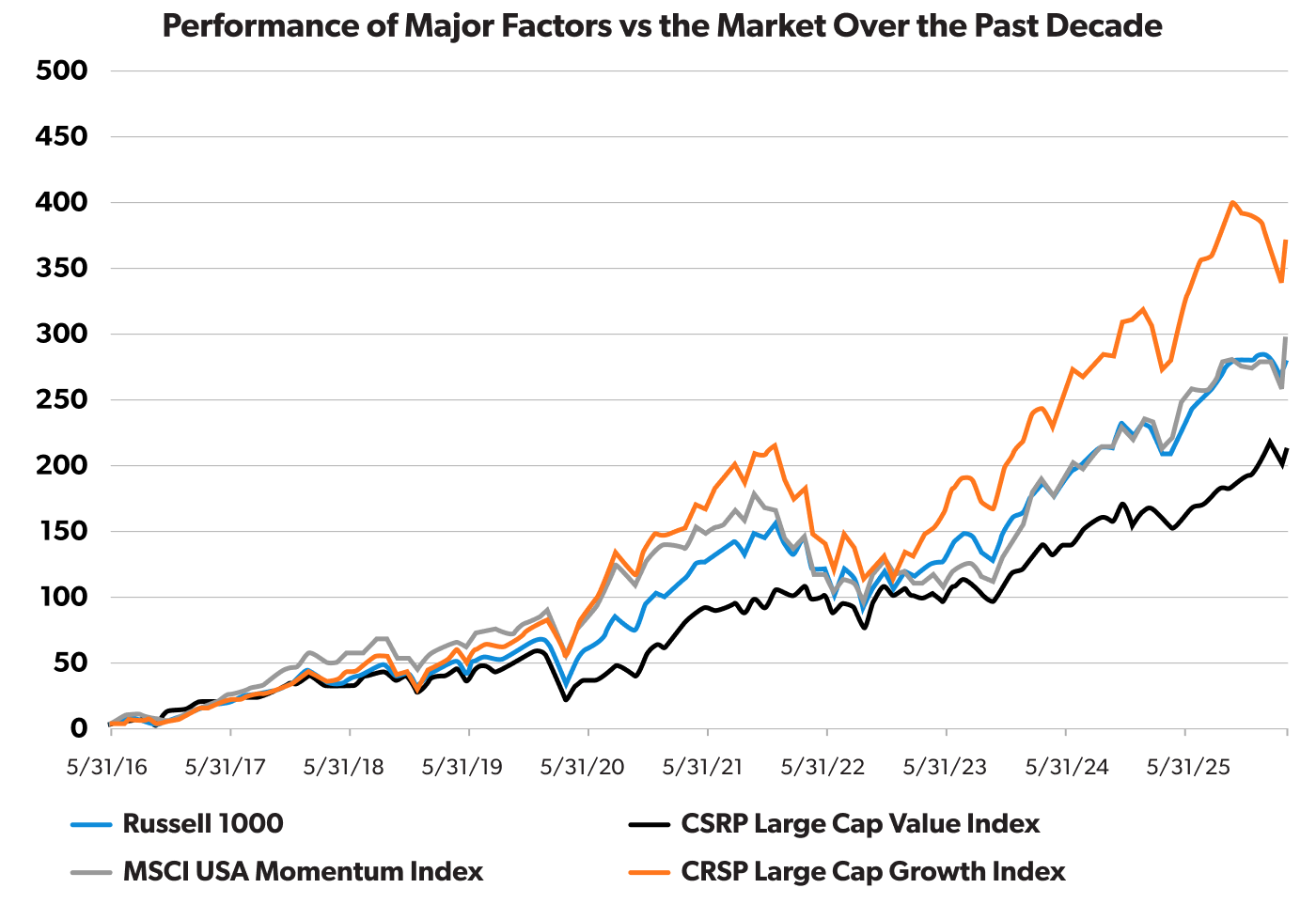
Over the performance period of May 31, 2016 to April 13, 2026 in the graph above (the “Performance Period”)1, value markedly underperformed the broad market and the growth and momentum factors.2 Within that same Performance Period, though, we found that value had some standup moments that may have served investors when the broad market was comparatively weak. That’s where a value product and an appropriate allocation suited to your goals could have come in handy.
Momentum investing: Objects in motion…
For the reward of a self-administered pat on your back, finish the back half of Newton’s first law of motion.
Alright, fine. An object in motion stays in motion. This is precisely what the momentum factor seeks to capture—excess returns over the market from companies with a relatively recent track record of strong performance. The assumption is that those companies should maintain their momentum (on the nose, I know, but it really is that simple) and that one can scoop some cream off the top by directly exposing their portfolio to this factor.
Over the Performance Period1, the momentum factor tracked large caps by the slimmest margin. We believe this comes down to the self-fulfilling prophecy of index and momentum factor performance. Market cap weighted indices can be whipsawed by the very positive or very negative performance of their largest companies. Therefore, when the top of the S&P 500 or Russell 1000 are leaving scorched tire tracks on the road, you’d expect to see them making up a good chunk of a momentum factor product.
Growth investing: Growing the distance
Last but certainly not least, we have growth. At a high level, the growth factor targets companies that demonstrate above-average earnings and/or revenue growth compared to the broad market. This market is no stranger to the headlines around high-flying growth companies.
Today, these are largely the Mag 7 and every major corporation related to either AI agents, data centers, or semiconductors. In years past, it was a cohort of enterprise software companies that swelled to the top of the market and have recently pulled back on perceived competition from AI capabilities.
The allure seems simple, right?
As with other factors, the key is managing one's direct exposure to growth. Growth does not imply impenetrability. Over the Performance Period, growth outperformed value, momentum, and the broad market by robust margins. But, in the same way that value has shown more robust performance in certain parts of the business cycle, growth companies have faced their own trials. Remember the tech downturn of 2022? No one was singing about growth then.
Now, factor investing – or really any particular strategy – alone won’t quiet the noise of the daily headlines. They’re still going to come and we’re all still going to be beautifully irrational human beings (check out Dan Ariely’s Predictably Irrational, if you haven’t yet). I’m still going to open up my preferred news sites and crank on financial radio with my morning coffee. And, let’s be real, do you really want me to do anything less? Knowing in and of itself doesn’t create that panicked, pants-down feeling; lacking a path forward does that. But with a plan in place, potentially one that includes tilting in and out of certain factors, investors have a chance to feel more grounded even when the market winds are sweeping up portfolios left and right.
Until next time,
Shelby


Related Posts

Three Charts that Tell the Momentum Story
The foundation for what we now know as momentum investing is based on the theory that stocks that...

Part 2: What Capitalists Get Wrong About Capitalism

Mann on the Street
It doesn't matter whether the cat is black or white, as long as it catches mice.— Deng Xiaoping

How AI Invaded Your Father's Favorite Index
What comes to mind when you hear “The Dow Jones Industrial Average?” For me, a Gen Xer raised on...
Search the Insights Blog