








 5 min read


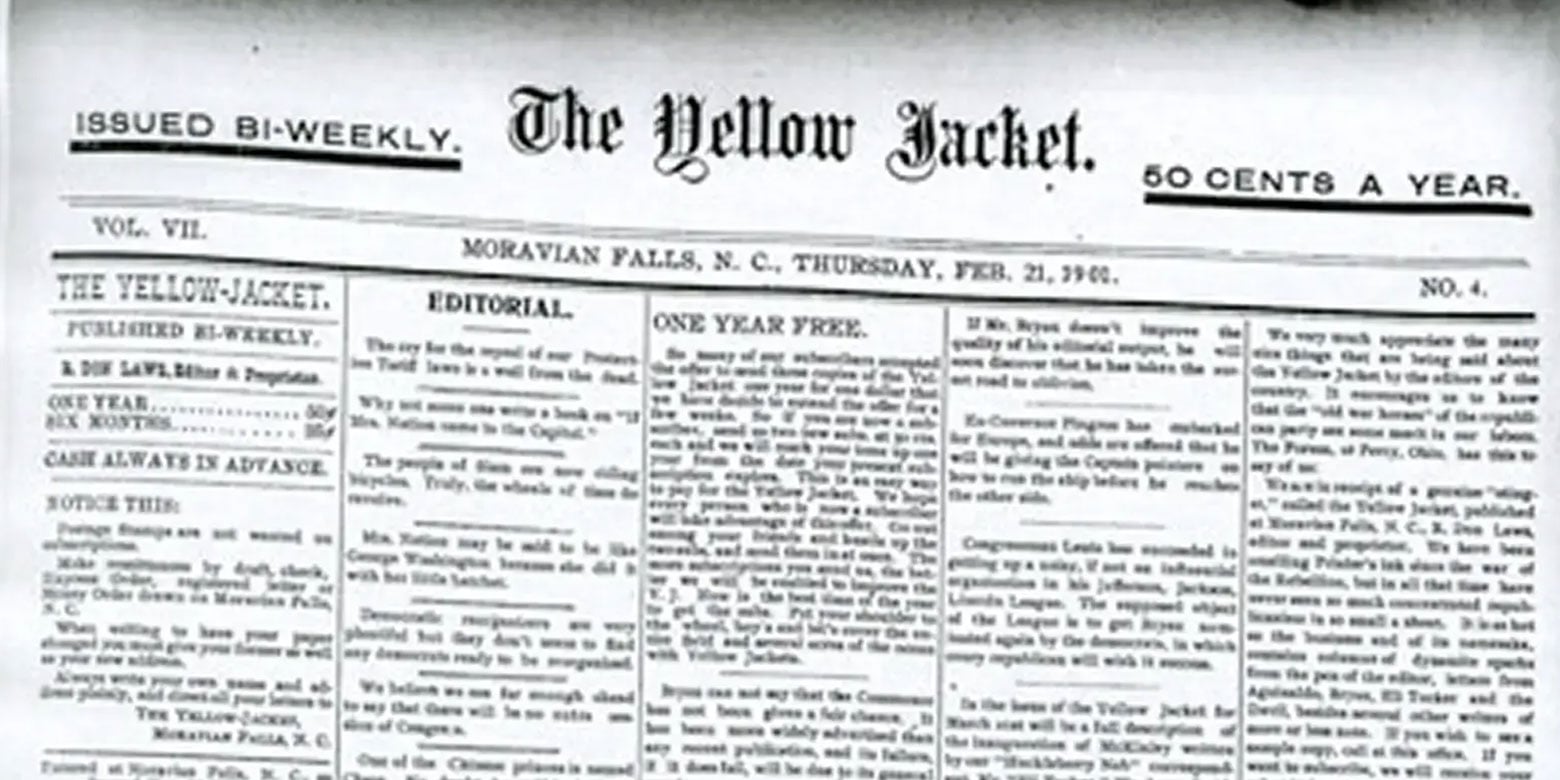
Wherever you are going, Moravian Falls, North Carolina is not on the way. It’s a tiny town, small enough that it doesn’t merit a mention on US421, a major highway that passes a few miles away. Which is why it was pretty weird that for a 20-year period this tiny town nestled in the foothills of the Blue Ridge Mountains became one of the most important publishing centers in the country.
In 1895, Moravian Falls had 250 residents, one of whom was a man named Romulus Don Laws. Laws had a little more than a year of formal education, which didn’t stop him from building a printing press at age 13. At 27, Laws began publishing The Yellow Jacket, a three-column, four-page, monthly newspaper. Rather than rehashing the news, The Yellow Jacket’s stock in trade was “stingers,” short venomous jabs aimed at Democrats as well as "Liars and Leeches, Hypocrites and Humbugs, and Demagogues and Dastards.1" (“Dastard” is one heck of a noun, by the way.)
Laws ignored nearly every rule about publishing. The primary one, it would seem, is that if you want to mail things, it helps an awful lot to be located in a place where you could actually mail things from. Moravian Falls couldn’t sustain a post office, so sending out issues required the publishers to transport tens of thousands of newsletters several miles to the nearest one, requiring special reinforced wagons to handle all the weight.
Another rule of publishing is that while a natural audience doesn’t guarantee success, it certainly helps. It’s why the biggest newspapers in this country come from places like New York and Washington DC.
So what happened next was perhaps even more absurd than the mere fact that The Yellow-Jacket was successful. Within a few years, Moravian Falls and its 250 residents didn’t just support a single newspaper – it became a printing capital that as many as 18 publications called home. Laws's brother Leonard launched The Lash. A former Yellow Jacket employee named James Larkin Pearson, the future poet laureate of North Carolina – because apparently this tiny village produced not only publishers but also, sure why not, poet laureates — launched The Fool-Killer. Moravian Falls, North Carolina became one of the most important publishing centers in the world.

A playing field devoid of competitors.
Whether he’d planned it or not, in writing to a segment of the population that the big newspapers ignored, Laws tapped into an incredible competitive advantage. His form of storytelling found a badly underserved audience whom no one else had bothered to reach. The rural Republicans in the post-Reconstruction South were a political minority, outnumbered and outvoted, and in The Yellow-Jacket, Laws spoke to them in exactly the language that resonated with them.
And boy did it ever resonate. Reliable numbers are hard to come by, but reasonable estimates (i.e., not ones from Laws himself) put The Yellow-Jacket’s circulation at its peak at more than half a million, with readers in every single state and several countries. That meant its reach approached that of the New York Times, and it was much larger than the most prominent southern newspapers, including the New Orleans Times-Picayune.
And then a piece of furniture ruined everything.
You don’t need to know the end of the story to know that this story ends with The Yellow-Jacket ceasing to exist. Moravian Falls does still exist but has returned to obscurity. In the 1930s, his most dangerous competition started finding its way into houses all across America.
Radio did what The Yellow-Jacket did – punchy, partisan political combat, but in real time and for free. FDR’s fireside chats were just stingers you could listen to while eating dinner. Father Coughlin reached more than 40 million listeners with the same kind of populist punchlines that Laws had been monopolizing in print for a generation. The Yellow Jacket didn’t lose out to a better newspaper; it lost to a wooden cabinet in the parlor.
The Yellow-Jacket kicked around until 1951, which, perhaps not coincidentally, was how long R. Don Laws kicked around. By this time, his paper was less of a going concern than it was a passion project that reminded an ever-decreasing number of people that R. Don Laws had at one point been pretty famous.
Why competitive advantages are not equal.
We can leave the question of whether R. Don Laws was a successful businessman or a failed one for another day. In truth, he was both. Businesses since the beginning of time dream of finding an untapped market like the one he found and dominated for several decades. That this competitive advantage faded over time is the nature of most competitive advantages. In the meantime, R. Don Laws, by any measure, was wildly successful.
The story of The Yellow-Jacket, though, is not a story of a great company. I don’t say this because it failed. I say this because its very structure meant that its competitive advantages – a receptive audience and a lack of competition – were by their very nature quite brittle. A brand, one of the most powerful forms of competitive advantage, might have helped for a while against similar newspapers but was worthless against the disruptive technology in the form of the radio.
Our stock in trade at Motley Fool Asset Management is to practice long-termism in investing. That is, we seek to find companies that we can hold for years at a time. One of the primary things we focus on is competitive advantages and attempt to apply them over a long-term time horizon. There, quite honestly, aren’t that many companies throughout the public markets that I’d describe as being truly great, and those opportunities are concentrated within certain segments of the market. It is difficult, for example, for an airline to be a truly differentiated long-term business, despite the fact that it is a growth industry with incredibly low cumulative pricing power.
Being long-term investors means focusing intently on the durability of a company’s competitive advantages as well as its susceptibility to both substitution and disruption. We see this all over the market these days, perhaps most notably with the heavy volatility in the software space as investors try to sort out which companies are susceptible to AI.
Let’s take another industry in turmoil: snacks. There are snack companies that have generated superior returns on capital for decades – growthy, sticky, delicious returns to shareholders. And then some scientist figures out that gila monster drool might be useful for stabilizing glucose2 and suddenly the world has a new category of miracle drugs that make people snack way less. There is a cliché about never underestimating the American eater, but I don’t think that cliché contemplated GLP-1s.
Successful orientation toward those segments that offer high moats and sustainable returns on capital offers an investor a path toward satisfactory investing results if that investor holds on long enough. Our happiest situations are companies that look expensive when we buy them but, due to these very factors, in the fullness of time, measured over years, will have looked very, very cheap.

If R. Don Laws’ story gives us anything, though, it is an example of an entrepreneur who likely would have been laughed out of an investor’s office when he started out, but then laughed out of that same investor’s office years later because what he had achieved would have been almost indistinguishable from fraud. The best companies, the best leaders, are often several steps ahead of the competition as well as the whims of the market. That’s why they win. This remains true even though the realities of capitalism mean that the world can, and will, change in ways that are difficult to predict.
R. Don Laws found and exploited a business cheat code. It’s all that we investors should ever want.
Related Posts

Part 1: What Capitalists Get Wrong About Capitalism

Mann on the Street
It doesn't matter whether the cat is black or white, as long as it catches mice.— Deng Xiaoping

The Bull Market Still Has More Room to Run
Every time the market hits a new all-time high, the financial chorus begins to sing their same old...

Why I'm Watching the Bond Market
Skim the financial headlines and you'll often see the same headline: "The bond market is signaling...
Search the Insights Blog